
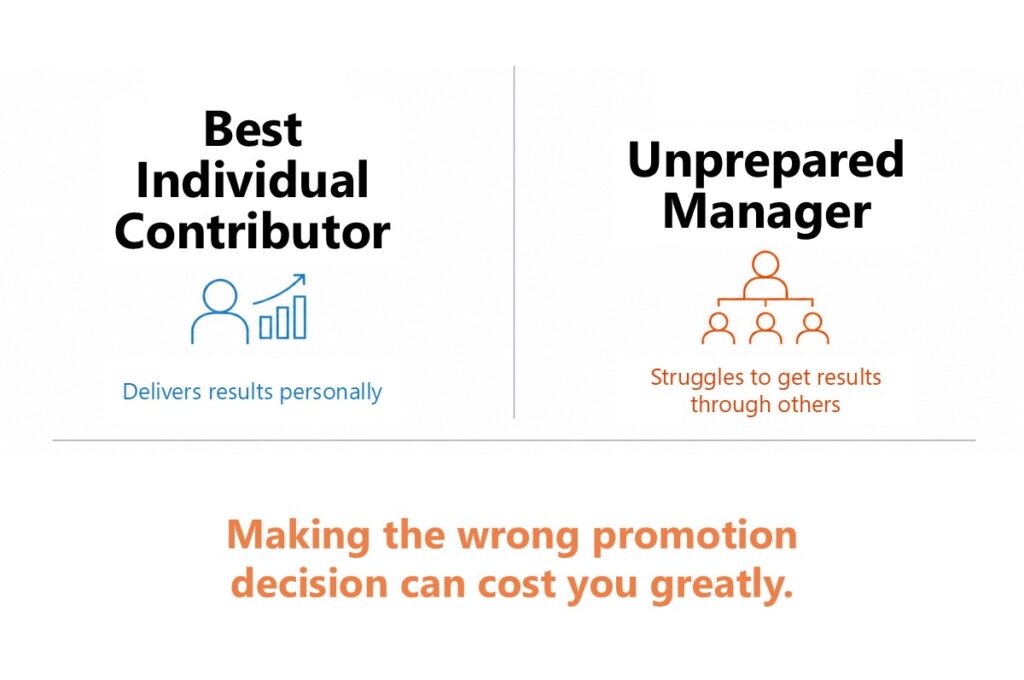
In the previous post, we explored what happens when organizations promote strong performers into leadership roles without preparing them for the transition and developing their leadership expertise. This week, I want to focus on how these “bad promotions” show up on your balance sheet. Because when this transition goes wrong, the cost isn’t theoretical. You not only feel the pain; you can also measure the impact.
Most organizations don’t notice the outcomes of a poor promotion decision immediately. At first, it looks manageable. This new manager is working hard and putting in extra hours. They are doing their best to stay on top of both their own work and the team’s performance.
But over time, the strain of not being ready—and not providing the new leader with the proper support—starts to show. Deadlines slip, productivity drops, and team morale takes a nosedive. As employee frustrations grow, talented people decide to leave. When employees leave, the cost extends far beyond replacing a single role.
Just for fun, let’s look at an illustration that includes some numbers.
In today’s service economy, a frontline manager might earn between $75,000 and $85,000 per year.1 The employees on their team are not far behind—many earn between $45,000 and $55,000 annually, depending on the role and market.2 (HR leaders are noticing this trend – that the gap between manager and employee pay is narrowing.)
These numbers matter, because when turnover happens under an unprepared manager, the organization is not simply replacing “cheap labor.” Rather, it is replacing skilled employees in an increasingly competitive labor market, and those costs add up quickly.
Research from the Society for Human Resource Management (SHRM) estimates the cost of replacing an employee can range from 50% to 200% of their annual salary, depending on their level.3 So in this example, when the promotion decision goes wrong, replacing the manager alone could easily cost around $80,000.
But the impact doesn’t stop there. Manager quality is one of the strongest drivers of employee turnover.4 So when managers are not prepared to lead, team engagement declines, and over time, employees leave. Subsequently, the organization incurs additional costs that extend well beyond the initial vacancy. These costs tend to show up in four areas.
- Team Turnover and Replacement Costs: Under an ineffective leader, it’s not uncommon to see increased turnover across the team. In this example, if just three employees leave—and each costs approximately 50% of their salary to replace—that would add another $60,000 in direct replacement costs.
- Lost Productivity: New leaders who aren’t prepared for the role often continue operating in their comfort zones as individual contributors. They stay buried in execution. They don’t delegate authority and develop their employees; instead, they step in to redo work and fix problems in their own way. The result is predictable: their own productivity declines, the team’s productivity never fully develops, and work slows down, even as effort increases. At the same time, new hires require time to ramp up, further reducing overall output.
- Loss of Institutional Knowledge: When those talented employees leave, they take more than their role with them. They take the context, relationships, operational knowledge, and informal ways of getting work done that comes from earned experience. This type of “brain drain” is difficult to quantify—but it directly affects performance and continuity.
- Team Instability and Disruption: Managers who are not prepared for leadership often create teams that are dependent on the manager for decisions, unclear about expectations, and inconsistent in execution. Instead of building capability, the system becomes fragile—and fragile systems depend too heavily on the manager to function. They struggle to sustain consistent performance and often break down under pressure.
Taken together, these factors compound the cost of a single poor promotion decision. So let’s step back and look at the full picture in this example.
- Manager replacement: ~$80,000
- Team turnover (3 employees): ~$60,000
- Productivity loss and disruption: ~$50,000
This would bring the total estimated cost for one bad promotion decision to about ~$190,000–$200,000 – and that’s using conservative assumptions.
This estimate doesn’t attempt to capture every downstream effect, such as the full impact of lost knowledge or the long-term erosion of your leadership bench. But even with a simplified view, the conclusion is clear. A single promotion decision—if it goes wrong—can cost your organization hundreds of thousands of dollars. And that cost rarely shows up all at once. It builds over time—through turnover, disruption, and lost performance.
Which means the real impact isn’t just financial, it’s systemic.
If you’re responsible for building leadership capacity in your organization, this is where the decision becomes clear. The question is not: “Can we afford to invest in developing our managers?”
The better question is: “Can we afford not to?”
Because the cost of getting it wrong is sure to show up—in turnover, in performance gaps, and in missed opportunities to build your next generation of leaders. You will pay for leadership development—either before the promotion, or after it.
Sources:
1 Salary: Service Manager (May, 2026) United States
2 Service Worker Salary: Hourly Rate May 2026 USA
3 The Myth of Replaceability: Preparing for the Loss of Key Employees