
You might think your leadership career begins when you are promoted into your first management role. Of course, that is when you’re responsible for the performance of others. So it makes sense – that’s where leadership “starts.”
This is a common way of thinking. But I disagree.
Leadership begins before this milestone. It starts before you have earned the promotion, before you have built a team, and before anyone is required to follow you. Leadership begins with how you lead yourself.
Last week, I referenced The Leadership Pipeline and its description of the passages that leaders move through over the course of their careers. The first passage is the transition from leading self to leading others.
When I first read about this passage, I remember thinking: Are we just assuming that everyone already knows how to lead themselves? How do ambitious young professionals actually learn how to do this? I think we don’t spend nearly enough time on where self-leadership comes from—or how it’s developed.
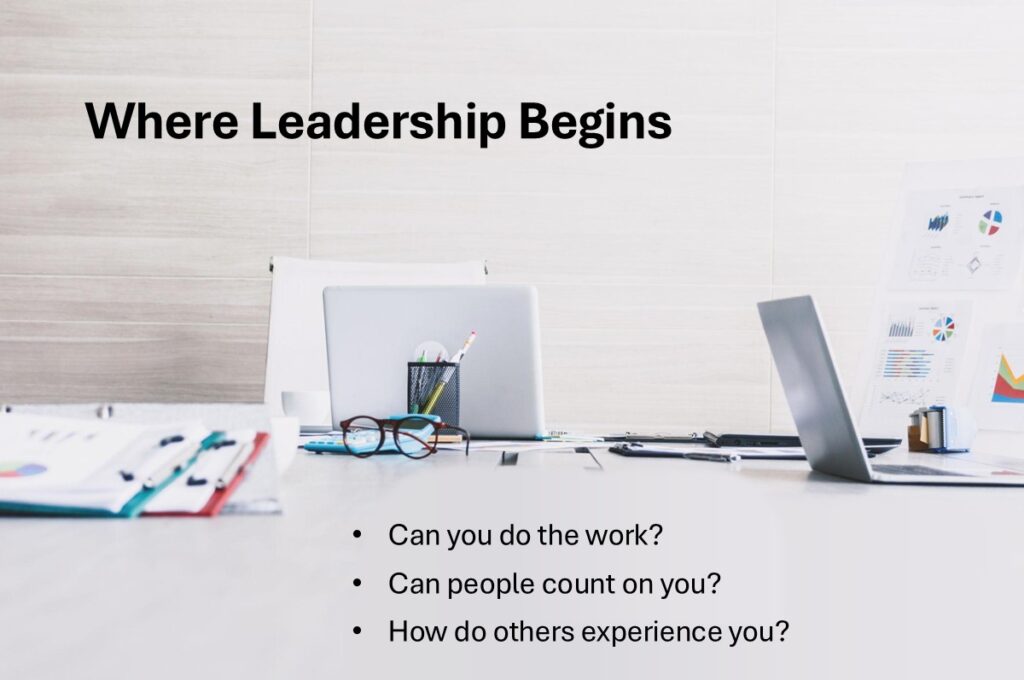
Self-leadership is about how you show up, while acknowledging that how you show up builds trust (or distrust) with others over time. In the workplace, people are constantly asking three questions about you, whether they realize it or not:
Ability — Can you do the work?
- Do you deliver quality results?
- Can you think critically, solve problems, and follow through?
Reliability — Can people count on you?
- Do you show up on time, and meet your deadlines?
- Do you do what you say you’ll do?
Relationships — How do people experience you?
- Are you someone who others want to work with?
- Do you collaborate well and contribute to a positive environment?
When you consistently demonstrate things mentioned here, people are more likely to trust you. And in the workplace, when people trust you, it enhances your reputation. A trustworthy person –someone who demonstrates self-leadership – is included in decisions and recommended for more responsibility. This is where those opportunities come from.
And as professionals, the challenge is this: We often assume that people just know how to do this. But the truth is, many don’t.
Young people get plenty of opportunities to learn and develop as they move through their early years of their education. But I think we could do a better job of making the emphasis on self-leadership more overt. Many people enter the workforce still not knowing how to lead themselves, and then they are left to figure it out while they are on the job. Some master the skill quickly, while others struggle quietly, unsure of what’s expected or how to adjust.
To give you an illustration, I can share my own personal example. In my earlier days, I was one of the people who struggled.
In one of my first work experiences, I found myself in a role that wasn’t bringing out my best. Don’t get me wrong, it was a good organization, and I liked the people. The work mattered — but I was not a right fit for the role.
And over time, that started to affect how I showed up at work. My engagement wasn’t what it could have been, and I lacked enthusiasm. I was doing the job—but I wasn’t really leading myself. The hard part was that I knew something was off, but I didn’t know what to do about it.
Around that time, I had a colleague named Alex. We worked on different projects, but we were both doing the same kind of work. I respected him and enjoyed the time we spent together in the workplace.
After about a year, he let us know he was leaving. We were surprised, and naturally, we wondered why. And then he said something I’ve never forgotten: “This work is important … but it’s not important to me.”
In that moment, he showed respect for the work we were doing, but he also showed a unique kind of agency. He was willing to step away from work that didn’t align with his most personal values, even when it was good work, in a good organization, with good people. That was self-leadership. And the reason his comment resonated with me was that I knew even then that this was something I hadn’t yet learned how to do.
That moment changed how I thought about my own situation. Eventually, I was able to make a move, and found work that shifted me from having a job to truly building a career.
Doing work that I loved changed everything about how I saw myself and how I showed up. My energy was different, engagement came easily. I built stronger relationships, and put in extra effort without being asked. I delivered higher quality work. It wasn’t only that I started showing up differently; it was also that others experienced me differently.
Here’s what I’ve learned since then. It’s easier to demonstrate self-leadership when you know your strengths, when you are in the right role, and when you can see a path forward. And it’s much harder when you’re misaligned or uncertain, or just showing up for a paycheck.
But over time, how you feel about your work does affect how you show up. People notice your energy and engagement, your ability to follow-through. They draw conclusions, and these conclusions affect how your leadership abilities are perceived.
You might think that you become a leader when you’re given a team to manage and others start following you. But the truth is this: You become a leader the moment you start leading yourself.