
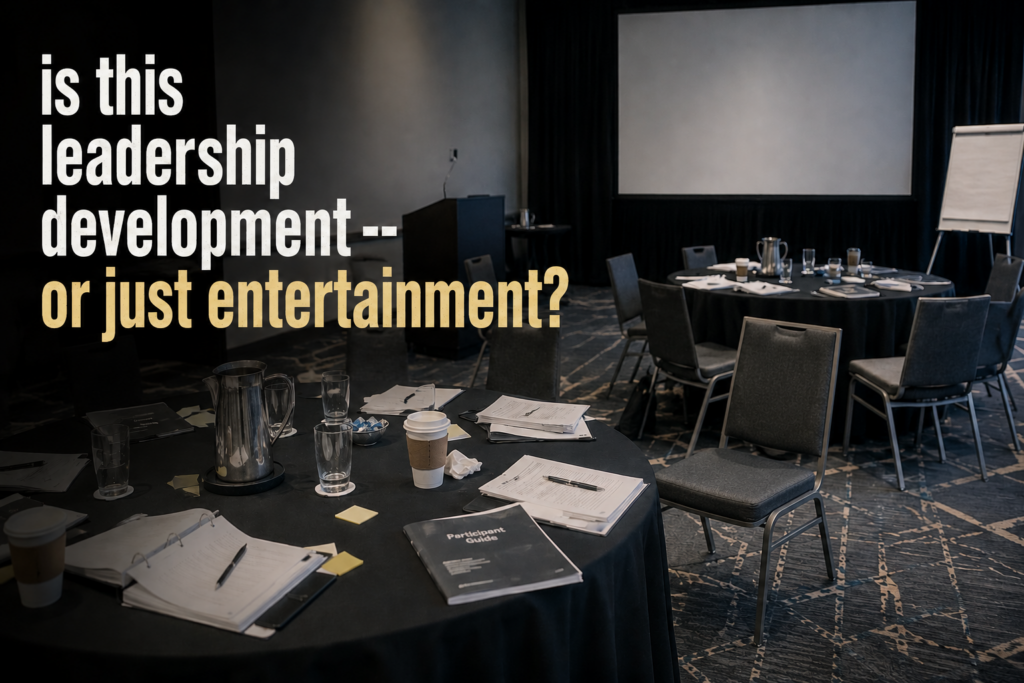
“Is this leadership development – or just entertainment?”
Some time ago, I was responsible for guiding the design of a leadership development program at a well-known entertainment company. Along with my facilitation partner, Richard, and a team of professionals, we created something remarkable.
During this 3.5-day program, professionals from around the world heard from dynamic guest speakers, participated in experiential activities, explored immersive field experiences, and got an inside look at what we believed were world-class leadership practices. The production quality was exceptional, and every detail was carefully orchestrated.
At the end of the program, participants often told us how meaningful the experience had been. Some became emotional as they described how the experience changed the way they thought about leadership. Many described the event as inspiring or transformational.
We were proud of what we had created, and we had the data to prove that people loved the experience. Guest satisfaction scores were consistently high, and after concerted efforts on our part, we saw the connection between participants’ intent to recommend the program and an increase in attendance because of those referrals.
But from the very beginning, I asked myself: What happens after they get back home? Do they actually become better leaders? Or did we simply entertain them for three days?
These unanswered questions fundamentally changed the way I think about leadership development. Because satisfaction is not the same thing as behavioral change, and that distinction matters far more than most organizational leaders realize.
For decades, learning professionals have relied on evaluation models like the Kirkpatrick Model, which distinguishes between participant reaction (“Did they enjoy it?”), learning (“Did they understand it?”), behavior (“Did they apply it?”), and organizational results (“Did it improve outcomes?”). (Kirkpatrick & Kirkpatrick, 2016)
The problem is that many leadership programs stop at the first level. People leave feeling energized. Their heads are full of ideas of what they could do next. They have binders of tools and materials, along with completion certificates, applause, and photos of their smiling faces.
Then they return to work … and nothing changes.
Exposure Is Not Transformation
Most leadership development fails because organizations confuse exposure to concepts and ideas with a personal transformation. It’s true that exposure creates awareness. It’s also true that transformation changes behavior. But these two things are not the same thing.
A workshop can absolutely help leaders understand new concepts by introducing them to frameworks, vocabulary, and ideas. Participants may even experience moments of deep insight. But insight alone rarely changes long-term behavior. Decades of research on training transfer suggest that learning fades quickly when it is not reinforced and applied in the workplace (Baldwin & Ford, 1988; Blume et al., 2010).
This is especially true for leadership development because leadership is not primarily theoretical work—it’s behavioral in nature. It happens in the face of professional pressure, ambiguity, conflict, uncertainty, and visibility. It happens during difficult conversations, competing priorities, political tension, emotional reactions, and moments where people must make decisions without perfect information.
You do not learn executive leadership by just discussing it. You learn it by applying leadership in real conditions.
Leadership Development Must Be Connected to Real Work
One of the biggest mistakes organizations make is separating leadership development from the actual environment where leadership occurs. Leaders attend a workshop in a hotel conference room for a few days, then return to an organization that rewards the same old behaviors.
This energized participant might be thinking, “I’ve got big plans for change!” But nothing in the surrounding system has changed. There is no reinforcement, no accountability, no structured follow-up, and no coaching. The participant returns to the same pressures, incentives, and habits that existed before the program began. In some cases, the participant’s direct supervisor was never even involved in the process. And yet organizational leaders are surprised when any potential behavioral impact disappears within weeks.
Real leadership development occurs through applied experience. It happens when leaders navigate organizational complexity while intentionally practicing new behaviors—under the real world conditions of pressure, ambiguity, conflict, and visibility. Leadership development becomes meaningful when leaders work on actual business problems while receiving structured support and feedback throughout the process.
Most Leaders Lack Useful Data from their Environment
Another major problem is that many leaders do not fully understand how others experience them. Their self-perception may be dramatically different from stakeholder perception. Without stakeholder feedback, meaningful growth becomes extremely difficult.
This is one reason why leadership development programs often fail to produce lasting change. Leaders may leave a workshop believing they are collaborative, approachable, strategic, or empowering — while their teams experience them very differently.
Honest feedback from stakeholders closes that gap. Research on feedback-seeking behavior suggests that leaders develop more effectively when feedback is reinforced, applied, and integrated into ongoing work relationships (Ashford, Blatt, & VandeWalle, 2003; Anseel et al., 2015).
But stakeholder involvement alone is not enough either. The most effective leadership development combines feedback and coaching, application and reflection, and accountability over time. This combination creates the conditions for sustained behavioral change.
Executive Leadership Is an Identity Transition
There is another reason leadership development is difficult. Executive leadership is not merely a skill upgrade; it is more like an identity transition.
Organizational leaders often assume that leadership development simply means teaching someone a few additional competencies. But the transition from manager to executive involves far more than learning new techniques. It requires leaders to rethink how they influence others, regulate emotions, build trust, and make decisions when competing priorities collide.
This is why leadership transitions often feel uncomfortable and disorienting. The behaviors that made someone successful earlier in their career may no longer be sufficient at higher levels of leadership. And that transition rarely occurs because someone attended a workshop. It occurs through guided practice, reflection, and adaptation over time.
What Actually Works
So what does effective leadership development actually look like? It looks less like an event and more like a process.
The strongest leadership development initiatives combine coaching, stakeholder feedback, real-world application, structured reflection, accountability, and reinforcement embedded into daily work. In other words, leadership development works when leaders are expected to do something differently — not simply learn something interesting.
Organizations spend billions of dollars annually on leadership development, yet many programs still struggle to create sustained behavioral change. The organizations that see meaningful results are usually the ones that stop asking, “Did participants enjoy the program?” and start asking, “What behaviors actually changed afterward?”
Sources:
Anseel, F., Beatty, A. S., Shen, W., Lievens, F., & Sackett, P. R. (2015). How Are We Doing After 30 Years? A Meta-Analytic Review of the Antecedents and Outcomes of Feedback-Seeking Behavior. Journal of Management, 41(1), 318-348.
Ashford, S. J., Blatt, R., & VandeWalle, D. (2003). Reflections on the Looking Glass: A Review of Research on Feedback-Seeking Behavior in Organizations. Journal of Management, 29(6), 773–799. https://doi.org/10.1016/S0149-2063(03)00079-5
Baldwin, T. T., & Ford, J. K. (1988). Transfer of Training: A Review and Directions for Future Research. Personnel Psychology, 41(1), 63–105.
Blume, B. D., Ford, J. K., Baldwin, T. T., & Huang, J. L. (2010). Transfer of Training: A Meta-Analytic Review. Journal of Management, 36(4), 1065–1105.
Kirkpatrick, D. L. (1959). Techniques for evaluating training programs. Journal of the American Society of Training Directors, 13(3), 21–26.