
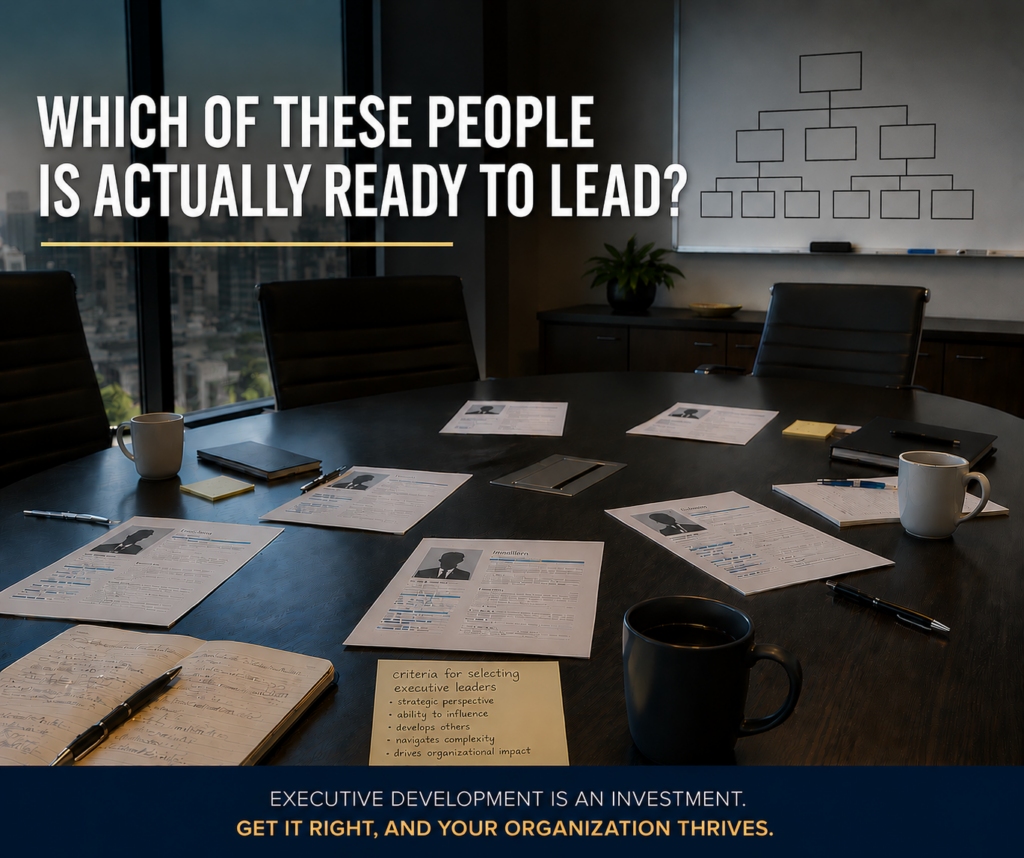
Not long ago, I was working with a team of organizational leaders during a succession-planning discussion. This organization already had clear leadership competencies, a talent-review process, and ongoing performance data. But as the discussion continued, I noticed something interesting happening.
They discussed one senior manager after another. One leader was described as “very loyal to our values.” Another was “one of the hardest working people in the company.” Someone else was praised for being “well-liked by the team.”
And then one of the leaders leaned forward and asked a question: “These are all great qualities, but which of these people is actually ready to lead at the executive level?”
The room got quiet for a moment, and there was a shift in the tone. This team knew that their organization was not lacking talented people; in fact, they had many. The problem was that the leaders in the room had realized that each of them – informally speaking – was using a different set of criteria for evaluating leadership potential. Some were evaluating technical performance, others were thinking about tenure and loyalty, and others were noticing visibility, charisma, or confidence.
It’s important to remember that executive development is expensive — financially, politically, and organizationally. Inevitably, leadership teams have to make difficult decisions about where to invest their time, attention, and development resources.
That raises the critical question: How do you identify who is truly ready for executive development?
Executive Development Is an Investment — Not a Reward
One of the most common mistakes leadership teams make is treating executive development as a reward for past performance. They have identified senior managers who have been loyal to the organization for years, who have consistently exceeded goals, or who are deeply respected in their respective departments. These leaders have “earned the right” to be considered, and “now it’s their turn.”
Don’t get me wrong – loyalty, hard work, and likability matter. But organizational leaders get into trouble when those qualities become substitutes for evidence of executive readiness.
Executive development is not a reward system for tenure, loyalty, or political goodwill. It is an investment decision that shapes the future capacity of the entire organization. Get it right, and your organization is positioned for long-term success. Get it wrong, and the negative consequences will ripple throughout your business for years to come.
The skills that help someone succeed as a strong individual contributor or department manager do not automatically translate into success at the executive level. In fact, some of the behaviors that create success earlier in a career can become liabilities in executive roles.
It’s not uncommon to see this pattern play out. A leader who succeeded primarily through his technical expertise struggled when he was no longer seen to be the smartest person in every conversation. A manager who thrived through having direct control over the work was unable to perform when promoted into a role where her success depended on trusting other leaders, and she needed to demonstrate influence and delegation.
Executive leadership requires a broader perspective. These leaders move from managing tasks and teams toward shaping the entire organization’s systems, culture, and strategic direction. The transition is more difficult than many people realize.
What Executive Readiness Often Looks Like
The good news is that executive readiness can be discerned, and research on leadership transitions has consistently shown that executive leadership requires fundamentally different skills, time applications, and work values than earlier management roles (Charan, Drotter, & Noel, 2011). With this in mind, experienced leadership teams can come to recognize the patterns that indicate readiness.
One of the clearest indicators is curiosity beyond one’s own area of responsibility. Future executives tend to ask questions about organizational strategy, customer experience, financial pressures, and long-term direction. They begin thinking beyond their own functional silo, and they begin to understand the organization as a larger system.
Another important sign is the ability to receive difficult feedback without becoming defensive. Executive-level roles place leaders under greater visibility and scrutiny. Leaders who cannot tolerate disagreement, criticism, or ambiguity often struggle as their responsibilities expand. In contrast, leaders with executive potential are capable of reflection and adaptation. They show an interest in continuous learning even under pressure.
The ability to influence across boundaries also matters. Many managers succeed because they possess positional authority inside their own departments. But executive leadership is different. These leaders need to influence peers, stakeholders, boards, clients, and cross-functional teams without relying solely on formal authority.
In many cases, leadership teams also look for evidence that a person is capable of developing others — not simply achieving results personally. Strong executives multiply leadership capacity around them. They build trust, create alignment, and help other leaders grow.
High Performance Does Not Always Equal Executive Potential
This can be one of the most difficult realities for leadership teams to navigate. Some of the top-performing employees in a company may have little interest in executive leadership. Others may want executive authority but struggle with the broader relational and strategic demands that come with it.
That does not diminish their value. Not every talented employee should become an executive. And not every successful manager should be placed on an executive succession path.
Sometimes organizational leaders confuse visibility with readiness. A highly charismatic employee may appear executive-like because they speak confidently in meetings. A technically brilliant manager may seem like the obvious next choice because they consistently solve operational problems.
In some organizations, leadership teams quietly feel pressure to reward tenure, loyalty, or visibility with advancement opportunities. But executive roles are too important to become symbolic rewards for past performance.
Executive leadership requires more than “performance” alone. It requires the ability to operate effectively amid uncertainty, competing priorities, incomplete information, and organizational complexity. That is a different type of work.
The Cost of Getting It Wrong
When organizational leaders misidentify executive potential, the consequences can be severe. Poor executive promotions create ripple effects across the organization. High-performing employees become frustrated, priorities stall, and political tension increases. In some cases, organizations lose strong technical performers after placing them into leadership roles that do not align with their strengths or interests.
The irony is that many failed promotions begin with some leader’s “good intentions.” Leaders want to reward performance, recognize loyalty, or create advancement opportunities. But executive roles should not simply be viewed as the “next step up.” They are fundamentally different responsibilities that require different capabilities. That is why thoughtful succession planning matters.
The Real Question
The strongest leadership teams are usually not asking: “Who deserves to be promoted?” They are asking: “Who has demonstrated the capacity to lead the organization into the future?”
Those are very different conversations. And they require organizational leaders to set aside many of the biases that naturally emerge in succession discussions — likability, loyalty, tenure, visibility, charisma, or the desire to reward years of hard work. Because executive leadership is not a ceremonial reward. It is a decision about the future leadership capacity of the organization.
When leadership teams place the wrong people into executive roles, the consequences extend far beyond a single promotion decision. Strong employees become frustrated, political tension increases, and organizational momentum slows. In some cases, organizations unintentionally damage both the business and the careers of people who may have been highly successful in different roles.
This is why thoughtful succession planning matters. Not because organizations need perfect predictions about people — but because the future of the organization will ultimately be shaped by the quality of the leadership decisions you make today.
Sources:
Charan, R., Drotter, S., & Noel, J. (2011). The Leadership Pipeline: How to Build the Leadership Powered Company (2nd ed.). Jossey-Bass.