
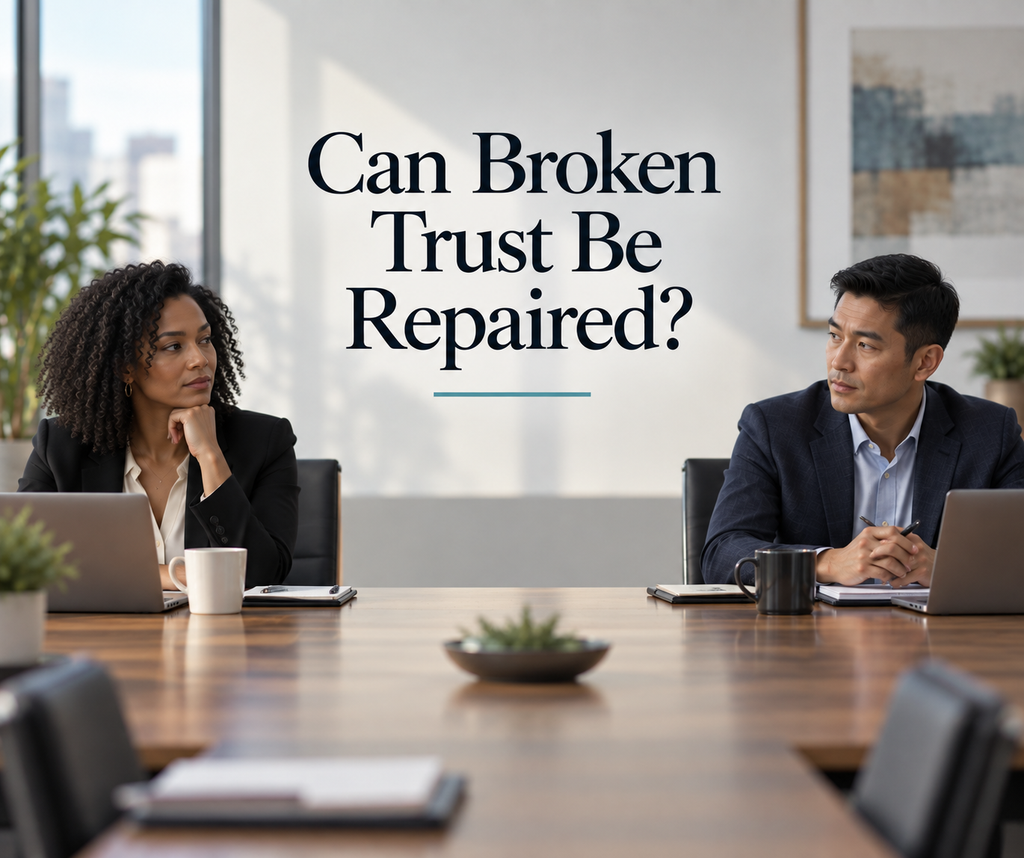
Whenever I am speaking to a group about trusting relationships in the workplace, there is one question that seems to regularly come up.
It usually happens later in the session, after participants have had a chance to think about what they have been learning. Because in my sessions, we don’t only talk about trust. We also talk about distrust and the damage it can cause.
After we have had a chance to unpack some of their own experiences with trusted and distrusted leaders, someone will raise a hand and ask a question that usually sounds something like this: “When trust gets damaged, can it be repaired?”
The pained expression on the person’s face often tells me there is a story behind the question. Maybe someone violated their trust. Or maybe they were the one who violated someone else’s. Either way, there is often a sense that they are hoping for some kind of a “do over.”
I typically start my response by saying, “You may not like my answer.” That’s because despite all of the research and attention devoted to understanding trust repair—and there is a substantial body of research on the subject—repairing damaged trust is difficult. But that doesn’t mean it’s impossible.
But before we talk about how trust can be repaired, I think there is another question we need to ask first: Are the conditions for trust repair even there? I think there are three things worth considering.
First, do both people know that trust was damaged?
This may sound like an obvious place to start, but I suspect it is where many attempts at trust repair end before they ever begin.
Think about what happens in our closest personal relationships. If your significant other or a family member suddenly stops talking to you, you are probably going to wonder: What’s going on? Did I do something wrong? Eventually, you may feel compelled to ask them about it.
Alternatively, when you are the person who feels hurt, you might initiate the conversation: “Something happened, and it’s bothering me. Can we talk about it?”
Those conversations can be difficult even in our closest relationships. In the workplace, the stress associated with confrontation can make these kinds of conversations even less likely to happen.
Power dynamics matter. Few employees are going to approach their boss and say, “You took this action, I interpreted it this way, and I feel that the trust between us has been damaged.” For many employees, a conversation like this may feel risky. And a manager may have no idea that something they said or did was interpreted by an employee as a violation of trust. So the relationship changes without either person ever talking about why.
The work continues, the meetings still happen, and the emails still get answered. Everyone remains professional. We might even describe the relationship as cordial. But sometimes “cordial” is just a nice way of saying that the warmth and vulnerability that once existed in the relationship are gone.
You cannot repair a trust violation that no one is willing to acknowledge.
Second, do both people want to repair the relationship?
Recognizing the damage is only the beginning. Trust repair requires two willing parties.
The person who violated the trust has to care enough about the relationship to acknowledge what happened and do the work necessary to repair it. The person whose trust was violated has to be willing, at some point, to reconsider what they now believe about the other person.
Either person can decide that the relationship isn’t worth repairing. And if they don’t change their mind about that, then the trust is beyond repair.
This is particularly important in the workplace, where people don’t necessarily get to choose whether the relationship continues. Two people who distrust each other may still have to work together. An employee may still report to a manager they no longer trust. Colleagues may still attend the same meetings and collaborate on the same projects even though trust between them has been damaged.
A working relationship can continue in a state of distrust, without trust being repaired. Again, it can be cordial. But cordiality isn’t trust.
Third, how deep was the trust before the violation occurred?
I use the word depth intentionally. Deep trust doesn’t develop from a single positive interaction. It develops through repeated experiences over time.
It looks something like this. I make a commitment and keep it. You take a risk with me and discover that it was safe to do so. I tell you something and you discover that it was true. We go through difficult circumstances together and learn how each of us will respond. Each experience provides another piece of evidence about our trustworthiness.
When that history is long and the trust is deep, the relationship may be more capable of absorbing a violation. Imagine that you have worked with someone for ten years and have found them to be consistently honest. Then one day you discover that they weren’t completely truthful with you about something important. That violation matters. But it also exists alongside ten years of evidence telling you something different about the person. In this case, you find yourself thinking: That’s not like them.
Now imagine that you have known someone for less than three months and discover the same thing. There isn’t much history competing with the new information. The violation may become one of the most important things you know about them – a moment that defines your judgment on this person’s trustworthiness.
The same trust violating behavior can therefore have a very different effect, depending on the relationship that existed before it happened. And that brings me back to the question I am so often asked: “When trust gets damaged, can it be repaired?”
Yes, I believe trust can be repaired. But there isn’t a “do over.” We don’t get to erase the violation and return the relationship to what it was before. What happened becomes part of the history of the relationship. The question is whether there is enough of a relationship left to build upon.
Do both people recognize that trust was damaged? Do both people want to repair it? Was there enough trust between them in the first place that this violation can become part of the story without becoming the entire story?
If the answer to these questions is yes, then trust repair may be possible. So before asking how to repair trust, we should ask whether the conditions for repair exist in the first place.
In my next post, I will talking about how people interpret different kinds of trust violations.